
European Arrival and the VOC on Java
European Arrival and the VOC on Java
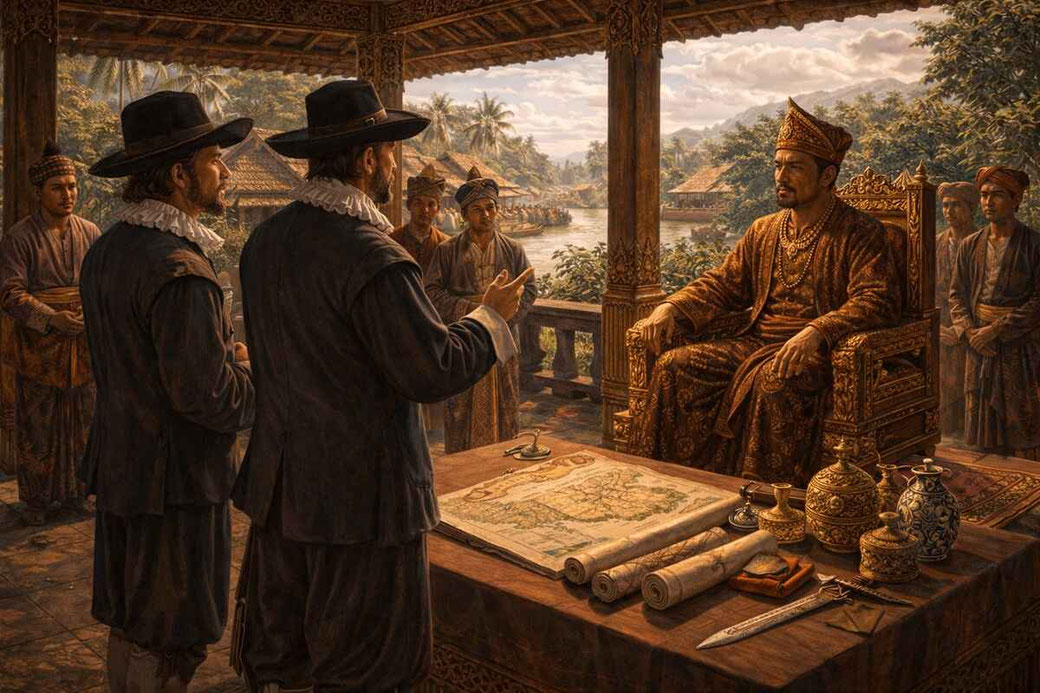
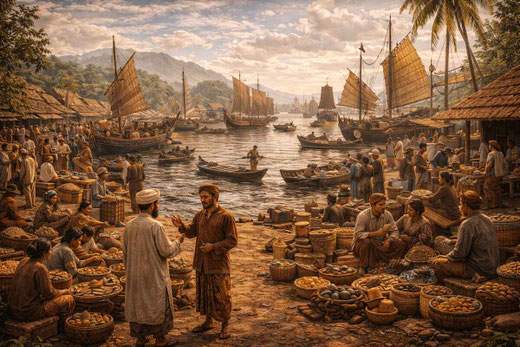
When European ships first appeared off the coast of Java in the late 16th century, they entered a world already shaped by powerful kingdoms, extensive trade networks, and centuries of cultural exchange. Java was no isolated island; it stood at the heart of Asian maritime commerce, linking the Indian Ocean with the South China Sea. Spices, rice, textiles, forest products, and precious metals flowed through its ports, attracting traders from Arabia, India, China, and Southeast Asia.
European involvement initially followed the same pattern as earlier foreign traders: exchange, negotiation, and coexistence. Yet the Europeans—particularly the Dutch—brought with them new ambitions, backed by naval power, military organization, and a corporate structure unlike anything Java had seen before.
The Birth of the VOC
In 1602, the Dutch government merged several competing trading companies into a single entity: the Dutch East India Company, commonly known as the VOC. Unlike ordinary merchants, the VOC was granted extraordinary powers. It could wage war, negotiate treaties, build fortresses, appoint officials, and administer territory—all in the name of trade.
Java quickly became central to VOC strategy. Its fertile lands produced rice to supply ships and settlements, while its ports offered access to the spice-producing islands further east. Control over Java meant control over the arteries of Asian commerce.
Trade as a Tool of Power
The VOC’s primary objective was profit, especially from spices such as cloves, nutmeg, and mace. Although these spices did not grow on Java itself, the island’s location made it indispensable. Ports like Banten, Jepara, and later Batavia became hubs where goods were collected, stored, and redistributed.
Trade agreements were rarely neutral. The VOC sought exclusive contracts, forcing local rulers to sell certain products only to the Dutch and at fixed prices. In return, rulers received military support, weapons, or recognition against rivals. What appeared as commerce often functioned as a lever for political dominance.
Over time, free trade gave way to monopolies. Independent merchants—Asian and European alike—were pushed out or violently suppressed. This marked a fundamental shift in the nature of Java’s economy, from open exchange to controlled extraction.

Batavia: A New Power Center
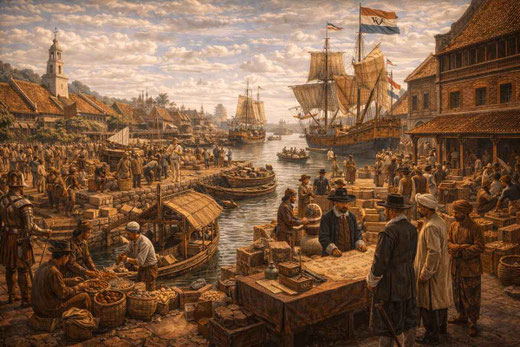
In 1619, the VOC destroyed the port city of Jayakarta and built Batavia on its ruins. This fortified city became the administrative heart of Dutch operations in Asia. From Batavia, the VOC coordinated trade routes, military campaigns, and diplomatic relations across the archipelago.
Batavia was not merely a trading post; it was a statement of intent. Its walls, cannons, and European-style governance symbolized a permanent presence. Yet it also depended heavily on Javanese labor, agricultural production, and cooperation with local elites. Power on Java was never exercised in isolation.

Alliances and Interventions
Rather than conquering Java outright, the VOC relied on alliances with local rulers. Javanese politics at the time were complex, marked by rival courts, succession disputes, and regional ambitions. The VOC exploited these divisions skillfully.
By supporting one ruler against another, the Dutch gained influence without large-scale occupation. Military assistance came at a price: territorial concessions, trade privileges, or political dependence. Over decades, this strategy transformed the VOC from a foreign trader into a decisive political actor.
Wars involving Javanese kingdoms increasingly became entangled with Dutch interests. The outcome of conflicts was no longer determined solely by local forces, but by access to European weapons, ships, and financial backing.
Violence Behind the Trade
Despite its commercial image, VOC power rested heavily on violence. Naval blockades, bombardments, forced relocations, and punitive expeditions were common tools. Resistance—whether from local rulers, merchants, or communities—was often met with brutal retaliation.
These actions were justified in European records as measures to protect trade, but for many Javanese communities, they represented a loss of autonomy and security. Coastal regions were particularly affected, as ports became militarized zones under foreign influence.
Yet the VOC lacked the manpower to fully control Java’s interior. Its power was strongest along the coasts and key trade routes, weaker in rural and mountainous regions where local authorities retained considerable autonomy.

Economic Transformation
The VOC era introduced new economic dynamics to Java. Forced deliveries, cash crops, and altered land use began to replace traditional systems of production. Some elites benefited, gaining wealth and status through cooperation with the Dutch. Others lost land, influence, or independence.
Java’s role shifted increasingly toward supporting VOC operations: producing food for ships, supplying labor for construction, and serving as a logistical base. These changes laid the groundwork for later colonial exploitation but had not yet reshaped everyday village life across the island.
Limits of VOC Control
Despite its power, the VOC was never omnipotent. Corruption, logistical challenges, tropical diseases, and resistance drained its resources. Maintaining forts, armies, and fleets was expensive, and profits were often lower than expected.
By the late 18th century, the VOC was deeply in debt. Mismanagement and changing global conditions weakened its grip on Asia. In 1799, the company was dissolved, and its assets were taken over by the Dutch state—marking the transition from corporate rule to formal colonial administration.
A Turning Point in Java’s History
The VOC era represents a crucial threshold in Java’s past. European influence shifted from temporary trade to structural power. Local rulers were no longer dealing with foreign merchants alone, but with an organization that combined commerce, diplomacy, and warfare.
While Java remained culturally Javanese and politically fragmented, the balance of power had irrevocably changed. The foundations were laid for the colonial system that would emerge in the 19th century—an era explored in the next chapter.
