The Rise of Islam on Java
Trade, Faith, and Transformation

A New Faith Arrives by Sea
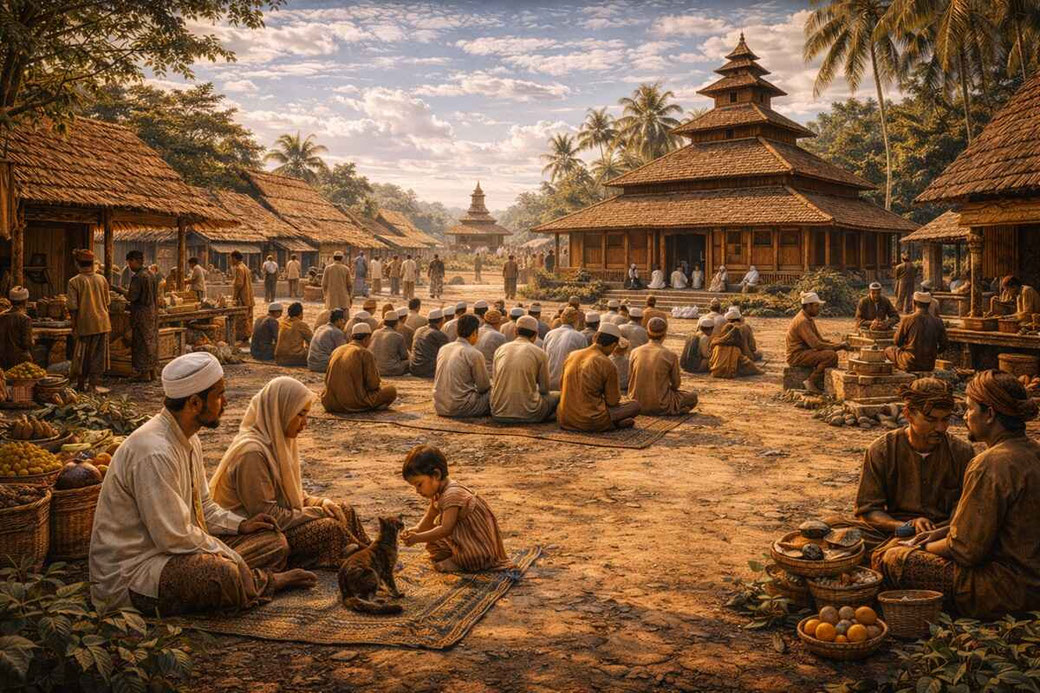
Islam did not arrive in Java through conquest, but through trade and cultural exchange. From the 7th century onward, Muslim merchants from Arabia, Persia, India, and later China frequented the maritime routes of Southeast Asia. Java, strategically positioned along these routes, became a natural meeting point of goods, ideas, and beliefs.
By the late Majapahit period, Muslim trading communities had already established themselves in coastal port towns, where commerce flourished and foreign influence was strongest. Islam first took root here—not in royal courts, but among merchants, sailors, and local elites connected to international trade.

Coastal Ports as Gateways of Change
The earliest Islamic centers in Java developed in port cities such as Gresik, Tuban, Surabaya, and Demak. These towns were outward-looking, economically dynamic, and culturally flexible.
Local rulers soon realized that adopting Islam could strengthen diplomatic and commercial ties with the wider Muslim world.
Rather than replacing existing structures overnight, Islam gradually integrated into Javanese society.
Early converts often continued older customs, blending Islamic beliefs with Hindu-Buddhist concepts and indigenous spiritual traditions.
The Role of the Wali Songo
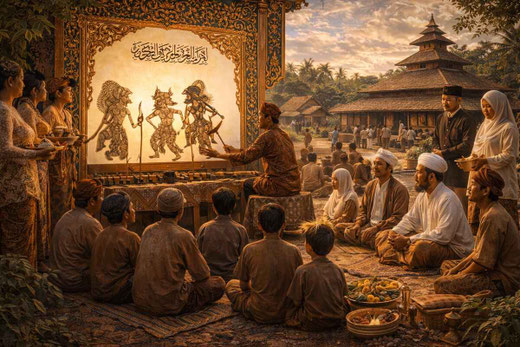
Central to the Islamization of Java were the Wali Songo, the legendary Nine Saints.
Though partly historical and partly symbolic, they represent a generation of Islamic teachers who understood that conversion required adaptation, not confrontation.
Each wali taught Islam through methods familiar to Javanese society:
- Wayang shadow plays
- Local music and poetry
- Community rituals
- Ethical storytelling
Instead of rejecting existing beliefs, they reframed them within an Islamic worldview. This approach allowed Islam to spread peacefully and sustainably.

Mysticism and Sufism
A key factor in Islam’s acceptance was Sufism, the mystical branch of Islam. Its emphasis on inner spirituality, meditation, and personal devotion resonated strongly with existing Javanese spiritual practices.
Concepts such as:
- Inner harmony
- The unity of existence
- The spiritual journey of the soul
were easily understood within the Javanese worldview. This spiritual compatibility helped Islam gain deep roots beyond surface-level conversion.
The Fall of Majapahit and Political Change
As Majapahit weakened in the late 15th century due to internal struggles and shifting trade routes, Islamic coastal states gained influence. The symbolic turning point came with the rise of the Demak Sultanate, often regarded as Java’s first Islamic kingdom.
Demak did not violently overthrow Majapahit; instead, it inherited much of its administrative and cultural framework. Court traditions, symbolism, and governance structures continued—now reinterpreted through an Islamic lens.
Islam and Javanese Kingship
Unlike the Hindu-Buddhist concept of divine kingship, Islamic rulers emphasized moral authority, justice, and religious legitimacy. Yet Javanese rulers retained elements of sacred kingship, creating a unique hybrid political culture.
Mosques replaced temples as centers of power, but their architecture often reflected older forms: tiered roofs instead of domes, symbolic gates reminiscent of Majapahit design, and strong alignment with cosmological principles.

Rural Java and Gradual Conversion
While coastal regions embraced Islam relatively early, inland Java converted more slowly. Here, older beliefs remained strong, and Islam blended further with ancestral traditions.
This gradual process produced what is often called Javanese Islam—a faith deeply rooted in ritual balance, social harmony, and respect for tradition. Even today, echoes of this synthesis remain visible in Javanese ceremonies, values, and daily life.
A Lasting Transformation
By the 16th century, Islam had become the dominant faith of Java. Yet it was not a replacement of the past, but a transformation shaped by dialogue, compromise, and creativity.
Islam on Java became:
- Peaceful rather than militant
- Inclusive rather than exclusive
- Cultural rather than doctrinal
This unique path explains why Javanese Islam remains distinct within the wider Muslim world.