The Legend of Sewu Temple

Across the plains of Central Java, not far from Prambanan, stands the vast temple complex known as Sewu Temple. Its name means “a thousand temples,” yet no one has ever been able to count that many. The reason, according to legend, lies in betrayal, pride, and an interrupted act of supernatural creation.
Long ago, Sewu Temple was connected to the same age of rivalry and power as the story of Bandung Bondowoso and Roro Jonggrang. After his humiliation and the loss of the princess, Bandung Bondowoso withdrew from the royal courts, consumed by anger and wounded pride.
Still possessing immense supernatural strength, he sought to prove that his power could not be denied. Rather than building a single grand monument, he vowed to create an entire complex of temples — greater than any kingdom could imagine.
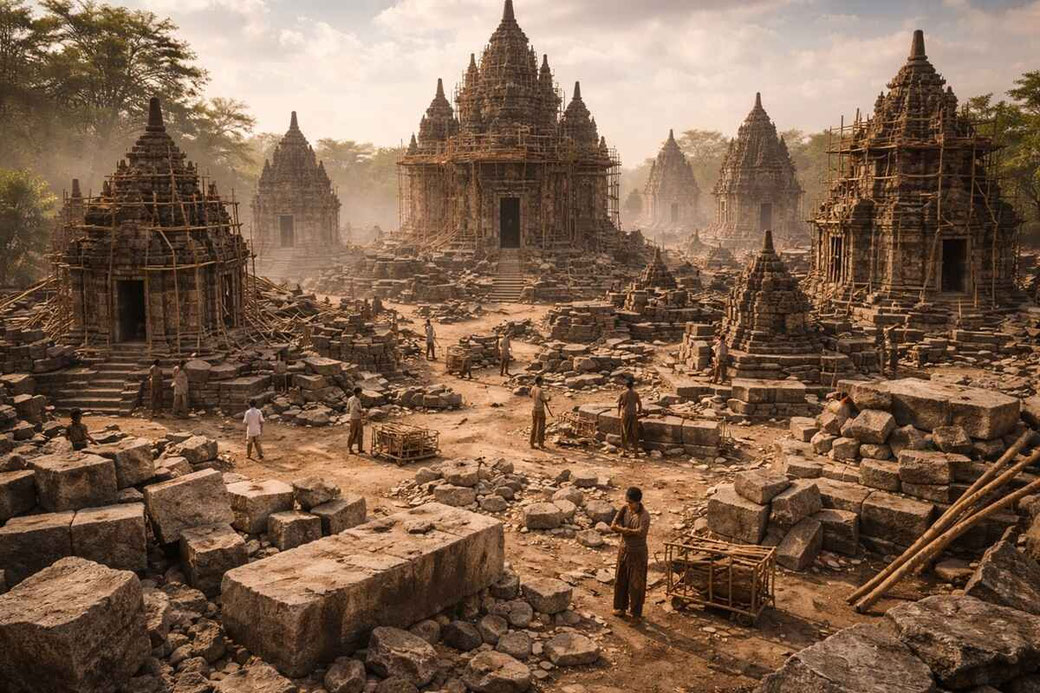
Under the cover of night, he summoned unseen forces once more. Stone blocks moved without hands, foundations formed across the land, and dozens of temples rose simultaneously. Unlike the orderly construction of Prambanan, Sewu grew chaotic, spreading outward like an unstoppable force.
But the wound left by Roro Jonggrang’s deception had not healed. As Bandung Bondowoso worked, doubt crept into his mind. His focus fractured, and the spirits he commanded grew restless. Without harmony, their work became imperfect.
Before the complex could be completed, dawn broke.
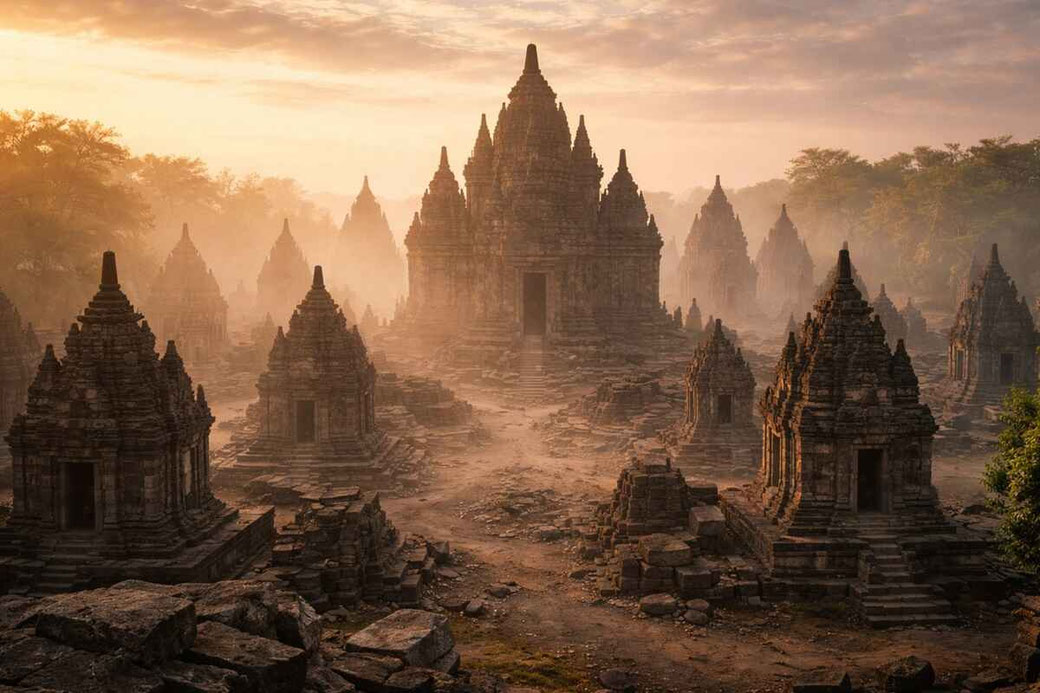
The spirits vanished, leaving the temples unfinished. Some stood whole, others half-formed, and many collapsed into ruin. Enraged, Bandung Bondowoso abandoned the site, leaving behind a landscape of stone that would never be fully completed.
Villagers later approached the ruins with caution. They believed the temples were not empty, but inhabited by spirits left behind when the construction was abandoned. At night, sounds of movement echoed among the stones, and travelers avoided the area after sunset.
Over time, the site became known as Sewu — not because a thousand temples stood there, but because they were intended to exist. The unfinished state of the complex served as a warning against ambition driven by pride rather than balance.
Today, Sewu Temple stands as one of Java’s most mysterious sacred sites. Its scale suggests greatness, yet its incompleteness tells a deeper story — that power without harmony leaves only fragments behind.
additional information (Factual Background)
Historical Reality
Sewu Temple (Candi Sewu) is a large 8th-century Buddhist temple complex, historically associated with the Sailendra dynasty. Archaeological evidence shows that it was once a major religious center.
Myth and Landscape
Local legend reinterprets Sewu Temple as the result of supernatural construction linked to Bandung Bondowoso. This myth provides a narrative explanation for the complex layout and unfinished appearance of some structures.
Connection to Roro Jonggrang
Sewu Temple is often woven into the broader mythological cycle surrounding Prambanan, Bandung Bondowoso, and Roro Jonggrang. Together, these stories form a shared mythic landscape explaining Central Java’s sacred architecture.
Spiritual Atmosphere
Many locals believe the site retains spiritual presence. Respectful behavior is encouraged, reinforcing the idea that Sewu is not merely a ruin, but a living sacred space.
Regional Variations Across Java
While the Sewu Temple legend is strongest in Central Java, similar stories of unfinished sacred construction appear elsewhere on the island. These variations reflect a shared belief that spiritual imbalance can interrupt even the greatest human ambitions.