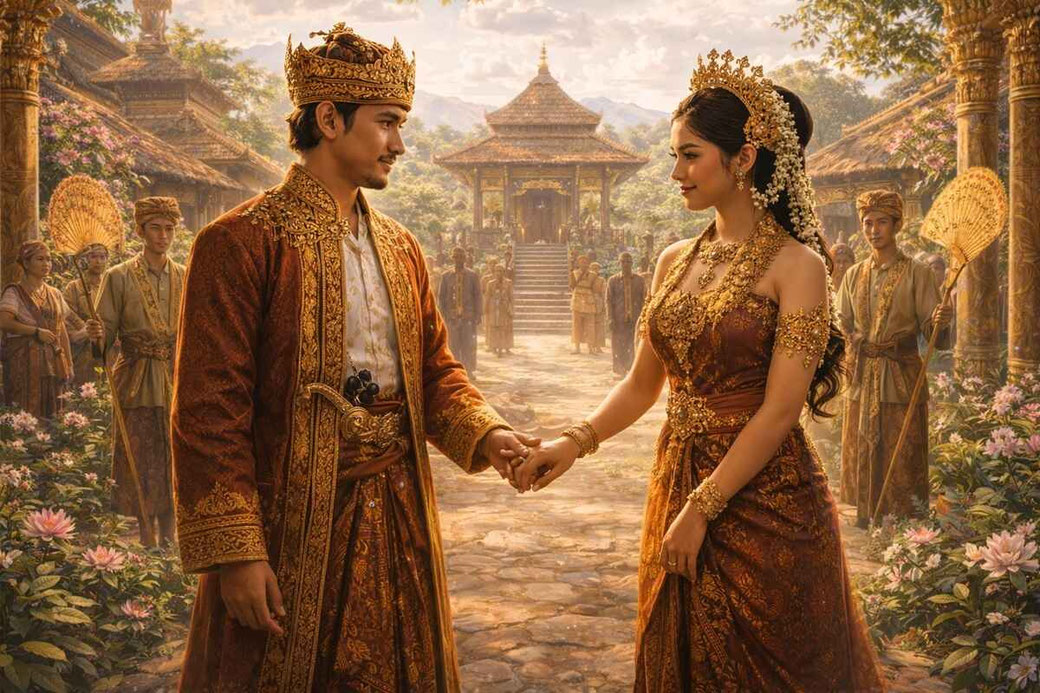
Panji & Sekartaji
The Majapahit Romance

During the golden age of Majapahit, there lived a noble prince named Panji Asmoro Bangun, known for his wisdom, refinement, and courage. He was betrothed to Princess Sekartaji, a woman admired for her beauty, intelligence, and grace.
Before their marriage could take place, fate intervened.
Through political intrigue, jealousy, or supernatural forces — depending on the version — Sekartaji mysteriously disappeared from the palace. The loss plunged the court into sorrow, and Panji vowed to find her, no matter how far he had to travel.
Disguising himself as a commoner, Panji left the palace and wandered across forests, villages, and distant kingdoms. Along the way, he faced challenges that tested not only his strength, but also his patience and compassion. Wherever he went, Panji earned respect through his gentle manners and sense of justice.

Unbeknownst to him, Sekartaji was also alive and wandering. Forced to conceal her true identity, she lived among ordinary people, enduring hardship while remaining faithful to her love. In many versions, she too adopted disguises, proving her resilience and independence.
After many trials and near encounters, fate finally reunited Panji and Sekartaji. Their identities were revealed, misunderstandings were resolved, and joy returned to the court. Their marriage symbolized harmony restored — not only between two lovers, but within the kingdom itself.
The Panji stories became widely celebrated, inspiring dance, theater, poetry, and shadow puppetry across Java and Southeast Asia. Their enduring popularity lies in the idea that love, when guided by loyalty and patience, can overcome even the longest separation.
additional information (Factual Background)
The Panji Cycle
The Panji stories form a vast cycle of tales told throughout Java, Bali, Thailand, Cambodia, and Malaysia, making Panji one of Southeast Asia’s most influential legendary figures.
Majapahit Court Culture
Panji embodies the refined ideals of the Majapahit nobility: self-control, courtesy, and moral balance.
Love Through Separation
Unlike tragic romances, Panji and Sekartaji emphasize perseverance and reunion, offering a hopeful vision of love rewarded.
Living Tradition
Panji narratives remain central to classical Javanese dance, masked performances (topeng), and wayang traditions.
Regional Variations
Some versions highlight Panji’s adventures, others focus more on Sekartaji’s resilience. East Java versions strongly emphasize Majapahit court culture and the balance between duty and emotion.