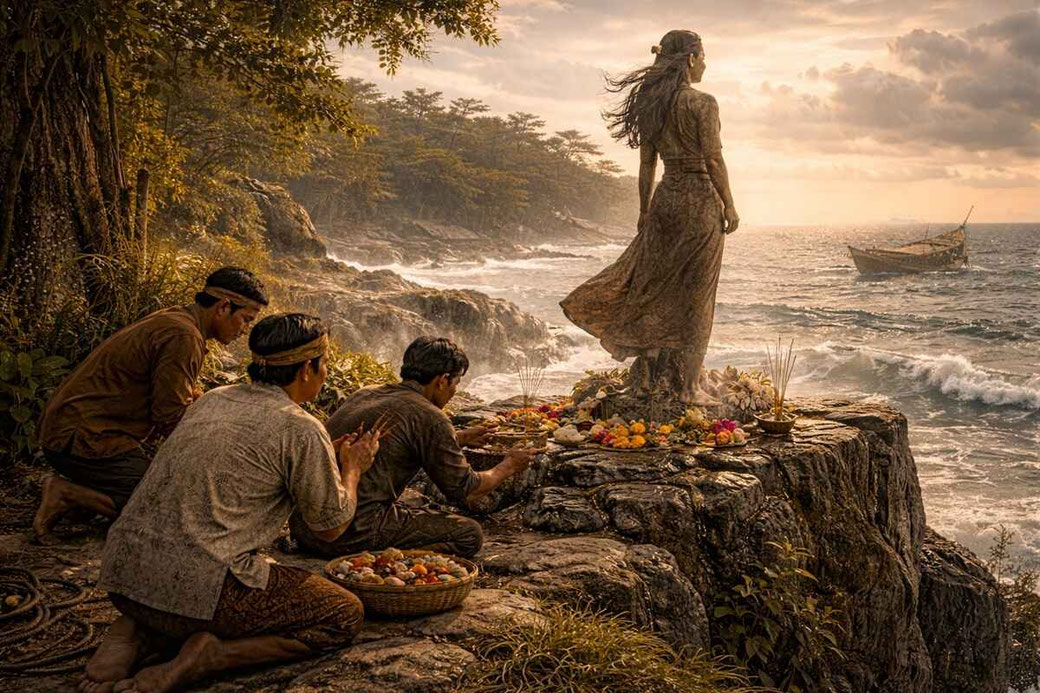
Karang Nini
The Rock of Eternal Loyalty

Along the rugged southern coast of West Java, where waves crash endlessly against dark cliffs, stands a solitary rock formation known as Karang Nini. Shaped by wind and sea, it carries a story older than memory — a story of devotion so strong it defied time itself.
Long ago, in a small coastal village, lived a young woman deeply in love with a fisherman who ventured daily into the unpredictable Indian Ocean. Before each journey, she waited on the cliffs, watching his boat disappear into the horizon. Their bond was built on trust, patience, and unspoken promises.
One season, storms came early. The sea grew restless, yet the fisherman set out as usual, assuring her he would return before nightfall. She remained on the shore, her eyes fixed on the horizon, believing in his words.
As the sky darkened, villagers urged her to return home. But she refused, convinced that leaving her post would break the bond that guided him back. Night fell, waves roared, and still she waited.

Days passed. The fisherman never returned.
Yet the woman remained on the cliffs, unmoving, her devotion unwavering. She stopped speaking, stopped eating, and waited in silence. Over time, the villagers noticed her body stiffen, her form slowly merging with the rock beneath her feet.
By the time they realized what was happening, she had turned to stone — her figure forever facing the sea.
From that day on, the rock was called Karang Nini, the “Grandmother Rock,” symbolizing loyalty that transcends life itself. Fishermen passing the coast offered prayers, believing her spirit protected those who remained faithful.
The legend teaches that loyalty is both powerful and dangerous — capable of guiding love, yet demanding sacrifice. Karang Nini remains a place of quiet reflection, where land and sea meet in eternal waiting.
additional information (Factual Background)
A Coastal Legend of West Java
The legend of Karang Nini originates from the southern coast of West Java, near Pangandaran. Unlike inland myths centered on kingdoms or agriculture, this story is deeply connected to the sea, coastal communities, and the emotional realities of separation, waiting, and loss.
Myth and Place Intertwined
Karang Nini is not only a story but also a physical landmark: a rock formation believed to resemble a young girl standing on the cliffs overlooking the ocean. The existence of the rock strengthens the legend, blurring the line between myth and landscape and turning the coast itself into a keeper of memory.
Oral Tradition and Fisher Communities
The story was passed down among fishing communities, where long absences, uncertain returns, and the dangers of the sea were part of everyday life. Karang Nini reflects these lived experiences rather than courtly or heroic ideals.
Symbolism & Meaning / Loyalty and Waiting
At the heart of the legend lies unwavering loyalty. Karang Nini symbolizes devotion that persists despite uncertainty, absence, and the passage of time. Her transformation into stone reflects endurance rather than tragedy.
The Sea as Separation
The ocean represents both livelihood and threat. It provides sustenance, yet it separates loved ones and claims lives without warning. The girl’s vigil embodies the emotional cost of coastal life.
Stone as Memory
Turning into stone does not signify punishment but permanence. Karang Nini becomes a lasting reminder of faithfulness, anchoring human emotion into the natural world.
Regional Identity (West Java / Sunda) / Coastal Sundanese Culture
West Java’s southern coast has long been shaped by fishing traditions and maritime uncertainty. Karang Nini reflects a Sundanese worldview that values patience, emotional restraint, and quiet strength rather than dramatic action.
Contrast with Other Regions
- West Java (Sunda): personal loyalty, emotional endurance, nature-bound memory
- Central Java: cosmic justice and royal symbolism
- East Java: transformation through ambition or sacrifice
Karang Nini stands apart as an intimate, human-centered legend.
Variations of the Legend / Different Endings
Some versions state that the girl willingly chooses to remain on the cliffs; others describe a gradual transformation caused by grief and longing. In all versions, her loyalty remains unquestioned.
Identity of the Girl
In some tellings she is a fisherman’s daughter; in others, the wife or beloved of a sailor. These variations allow the story to resonate across generations and social roles.
Cultural Legacy Today
Today, Karang Nini remains both a legend and a destination. Visitors to the cliffs near Pangandaran often hear the story told alongside the sight of the rock itself, reinforcing the idea that the landscape carries emotional memory. The legend continues to serve as a quiet moral lesson about loyalty, patience, and the enduring bond between humans and the sea.