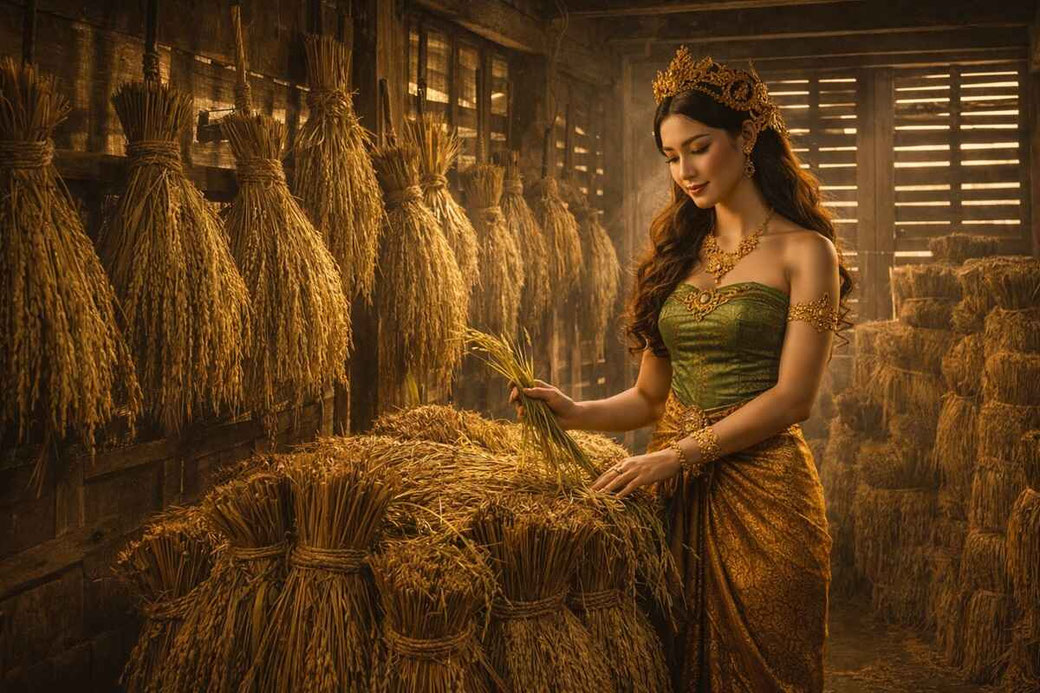
Dewi Sri
The Sundanese Harvest Legend

In the fertile valleys of West Java, where mist drifts over rice terraces at dawn, the name Dewi Sri has been whispered for centuries. She is not merely a goddess of crops, but a living presence woven into daily life — guiding farmers, blessing harvests, and maintaining the delicate balance between the human world and nature.
Dewi Sri is often described as gentle and radiant, adorned in simple garments the color of ripe grain. Unlike warrior deities or distant rulers of the heavens, she walks close to the earth. Her footsteps follow irrigation channels, her breath moves through the rice leaves, and her spirit rests in the barns where harvests are stored.
According to Sundanese belief, Dewi Sri emerged during a time when humans struggled to cultivate the land. Crops failed, hunger spread, and villages lived in constant uncertainty. Seeing this suffering, the gods granted Dewi Sri permission to descend to the mortal world and teach humanity the sacred rhythms of agriculture.
She showed the people how to read the seasons, how to prepare the soil, and how to plant rice in harmony with water and moon cycles. More importantly, she taught respect — for the land, for ancestors, and for unseen forces that sustain life. Farming became not an act of exploitation, but a spiritual partnership.
Over time, Dewi Sri became inseparable from rice itself. Each grain was believed to carry her essence. This belief shaped countless customs: rice was never stepped on, thrown away, or treated carelessly. Before planting, offerings were made. Before harvest, prayers were spoken. Even during meals, gratitude was expressed.

Unlike Nyi Pohaci Sanghyang Asri, whose myth speaks of cosmic sacrifice, Dewi Sri represents continuity and presence. She does not die to give life — she remains, season after season, renewing fertility through ritual and care. In this way, the two goddesses complement each other, forming the spiritual foundation of Sundanese agriculture.
Dewi Sri also served as a moral guide. Prosperity, it was believed, depended not on abundance alone, but on ethical behavior. Dishonesty, greed, or disrespect toward nature could drive her away, resulting in failed harvests or natural imbalance.
In village life, Dewi Sri was honored through ceremonies marking each stage of the rice cycle. Special songs accompanied planting, while harvest festivals celebrated her return to the granaries. Rice barns themselves were often treated as sacred spaces, sometimes decorated or blessed to welcome her spirit.
With the arrival of Hinduism and later Islam, Dewi Sri did not disappear. Instead, she adapted. Her worship became less overt, woven subtly into local customs rather than formal temples. This flexibility allowed her legend to survive across centuries of religious change.
Today, many Sundanese families still observe traditions connected to Dewi Sri, even if they no longer consciously frame them as worship. Respect for rice, seasonal rituals, and the belief that land must be treated with care all echo her enduring presence.
Dewi Sri’s legend reminds us that true prosperity flows from balance — between effort and patience, human need and natural limits. In the quiet rhythm of planting and harvest, her spirit continues to guide the people of West Java.
additional information (Factual Background)
Agricultural Origins in West Java
Dewi Sri is one of the most important spiritual figures in Sundanese culture, closely tied to agriculture, fertility, and the rice harvest. In West Java, her legend developed within farming communities that depended entirely on the success of seasonal crops. Unlike court-centered myths, Dewi Sri belongs to the fields, villages, and households of ordinary people.
From Cosmic Being to Household Spirit
In early belief systems, Dewi Sri appears as a cosmic force linked to fertility and life. Over time, she became more intimately connected to everyday life, evolving into a guardian spirit of rice granaries, kitchens, and harvest rituals. This shift reflects the Sundanese tendency to bring the sacred into daily routines rather than elevate it into distant temples.
Relationship to Nyi Pohaci
In Sundanese mythology, Dewi Sri is often identified as an aspect or continuation of Nyi Pohaci Sanghyang Asri. While Nyi Pohaci represents the primordial origin of rice, Dewi Sri embodies its ongoing presence — growth, harvest, and sustenance across generations.
Symbolism & Meaning / Rice as Living Spirit
Rice is believed to possess a soul (roh), and Dewi Sri is its spiritual guardian. This belief explains why rice is never treated carelessly and why rituals accompany planting, harvesting, and storage.
Feminine Care and Protection
Dewi Sri symbolizes patience, nurturing, and continuity. She is not a goddess of abundance through excess, but of balance through care. Prosperity comes from respect and attentiveness rather than force.
Cycle of the Harvest
Her legend reflects the cyclical nature of agriculture: planting, growth, harvest, rest, and renewal. Dewi Sri’s presence ensures that this cycle continues in harmony.
Regional Identity (West Java / Sunda) / Village-Centered Spirituality
In Sundanese society, spiritual life is closely connected to the village and household. Dewi Sri’s worship often takes place in rice barns (leuit), family compounds, or fields rather than monumental religious structures.
Contrast with Other Regions
- West Java (Sunda): household rituals, rice spirit, fertility
- Central Java: ceremonial agriculture tied to royal symbolism
- East Java: transformation myths and heroic narratives
Dewi Sri’s role highlights West Java’s emphasis on sustenance and continuity over power and conquest.
Variations of the Legend / Local Practices
Different villages maintain unique harvest rituals dedicated to Dewi Sri, often involving offerings, songs, and symbolic foods. These practices vary widely but share the same core belief in her protective presence.
Names and Interpretations
While Dewi Sri is known across Java, the Sundanese interpretation emphasizes her gentleness and domestic role more strongly than in other regions.
Cultural Legacy Today
Dewi Sri remains deeply woven into Sundanese cultural life. Harvest ceremonies, traditional songs, and agricultural customs continue to honor her spirit. Even in modern times, respect for rice in West Java reflects the enduring belief that Dewi Sri’s presence ensures nourishment, balance, and survival.