
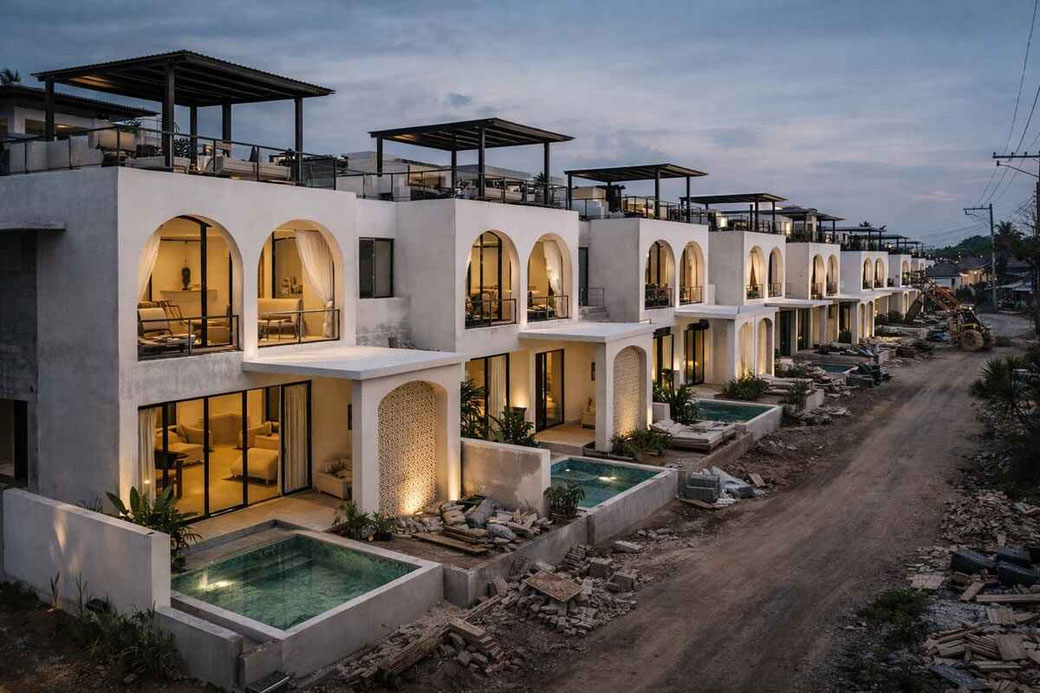
Have we reached a point where the property market in Canggu and the Bukit area (Uluwatu) is becoming saturated? Several signals suggest that this may be the case. Over the past months, we have had to implement multiple price reductions on existing villas. That is rarely a coincidence, but rather an indication that prices are no longer fully supported by demand.
In addition, we have noticed that project developers are now actively approaching us to list their properties. For years, many of them were able to sell their villas effortlessly — often directly from the drawing board. Today, we see completed units still looking for distribution channels. In our view, this clearly indicates that the market is cooling.
What makes this even more notable is that in many other parts of Bali, property prices remain stable or continue to increase. In Canggu and Bukit, however, we are witnessing growing pressure and rising competition within a highly homogeneous supply.
And that supply deserves a critical assessment.
Much of what has been built in recent years in these areas can hardly be described as innovative or architecturally inspiring. The market is largely dominated by nearly identical projects: small plots, minimal outdoor space, and pools that are, in reality, little more than oversized bathtubs marketed as luxury features. The now-standard rooftop terrace often serves as compensation for the lack of proper garden space at ground level.
These projects increasingly resemble production-line developments — designed primarily for maximum density and rapid sales. Architectural integrity, long-term sustainability, and thoughtful integration into the surrounding environment often appear secondary to short-term returns. This concern is not ours alone; several colleagues in the industry share similar reservations about the current direction.
Adding to this are frequently advertised projected returns of 15%, 20%, or even 25% annually. While attractive on paper, such figures are rarely sustainable in practice — particularly when dozens of nearly identical villas enter the same rental market simultaneously. Once investors realize that these returns are not consistently achievable, confidence inevitably declines. That shift appears to be happening now.

Does this create opportunities for bargain hunters?
For private buyers seeking a home for personal use, this may indeed be a favorable moment. Negotiation margins appear to be widening, and sellers are becoming more realistic. However, due diligence remains essential. Many of these projects were built quickly with a strong focus on short-term profitability. This does not automatically mean poor quality, but careful inspection is certainly advisable.
For investors, the situation is more complex. A lower purchase price does not necessarily compensate for a saturated rental market, potentially declining occupancy rates, and ongoing uncertainty surrounding rental licensing regulations. When projected returns weaken and competition intensifies, the risk profile changes considerably.
Then there is the apartment segment — effectively disguised luxury hotel rooms within larger complexes. The renders are always impressive: infinity pools, rooftop lounges, ocean or rice field views. Yet Bali already offers a substantial number of professionally managed resorts and hotels. The question therefore becomes: what truly distinguishes a single apartment unit enough to guarantee consistent occupancy?
From our experience, demand for apartments remains limited. Buyers looking to establish themselves in Bali typically envision space, privacy, and a private garden with their own swimming pool — not a unit within a building shared with dozens of similar apartments. Resale prospects can also prove challenging.
Overall, we gain the impression that the property market in Canggu and Bukit may have reached its natural limit — at least within the current model of compact, uniform developments supported by ambitious return projections. In other parts of Bali, we are not observing the same level of pressure at this time.
Markets inevitably correct themselves. The question is not whether they will, but when quality, differentiation, and realistic expectations will once again become the guiding principles.
We are curious to hear your perspective. Do you share our critical view of current developments, or do you see the situation differently? We welcome your thoughts in the comments below.
Write a comment
Sebastian (Saturday, 28 February 2026 22:54)
Bali was for years a beautiful island with an affordable entry market for foreign real estate investments dominated by contemporary traditional mixed villas were highly on demand.
However with the invasion of new developers also known as cowboys it becomes more the market for short terms gain rather than long-term sustainable value, timeless designs equipped with real infrastructure. Now the fasade starts to crack when thousands of tiny, poor build "investment villas" comes to the market. What will happen if most of the investors from the past 5 years want to exit their investment at the same time? A real estate market crash is unavoidable from my POV.
Winners in this market will be only developers and investors who did it right from the beginning who structure their business well with the company setup and right licenses, zoning, purchasing with well established developers and proven track record and quality builds. All bargainers and corner cutters will belong to the other side.
Another thing is the offered 25 years leasehold structure for investment. That what investors try to save from the beginning will cost you thousands in the long run. For example: a project with a 25 years leasehold needs 2 years for planing and construction. 1 year of testing the commercial rental market and 1-2 years of improving. Lets say it takes 7-8 years until break even. The leaseterm is now slightly more than 15 years. Who will be the next buyer ? Does it make sense to lease a property for this short term for investment. And yes, once money is made. Its time to pay the land again.
The system needs to be rewired to make it suitable for investors and landowners alike. The greedy way to increasing land prices leads to non sense developments and destroys the island. Results of the flat roof and white box villas is an increasing of area flooding with what people needs to live now.